

It is important that we stop and reflect when we are privileged to have a truly fantastic day; a day that leaves your brain and heart so full that the work doesn’t feel like work at all. My day with the library team at Pymble Ladies’ College was one of these days.
It was my pleasure to spend last Friday with the K–12 school library team and some of their teaching and leadership colleagues. From the outset, I appreciated their warmth and hospitality, but also that they came prepared with questions already forming, threads they wanted to pull, and a clear sense of what they were trying to figure out. From the opening session through to our closing reflections, the conversation flowed in both directions. I came with frameworks and provocations; they came with context, experience, and honest professional uncertainty. That’s the kind of room I learn in too.
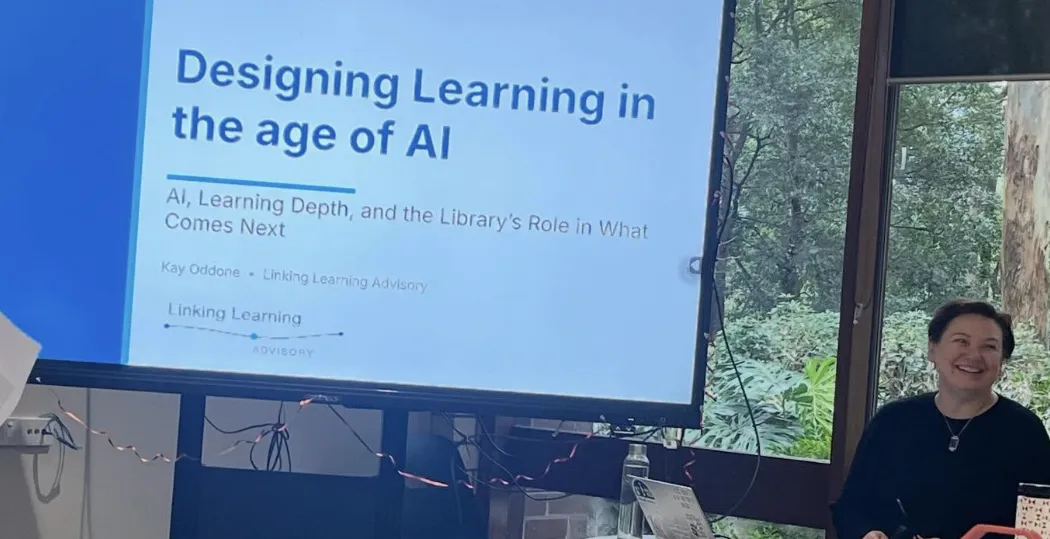
The day moved through several connected threads. We began with the big picture — the shifting landscape of AI in schools and what it means for library practice — before breaking into smaller groups to dig into specific challenges each cohort of library staff had wanted to explore. The concurrent workshops gave each group space to work deeply on questions most relevant to their context, and the cross-group synthesis that followed was genuinely inspiring. Hearing the Junior School and Senior School teams share back to each other, finding common threads across different student populations, was one of the high points of my day.
Throughout the morning, what was evident was that this team wasn’t fixating on AI as the problem to be solved. In a clear demonstration of how school library professionals’ work exceeds far beyond books on shelves, the conversations were about learning and teaching — situated within an AI environment, yes, but firmly anchored in pedagogy. There was a shared understanding that the more pressing challenge isn’t the technology itself, but how to redesign and reimagine learning and assessment in a space where content can be generated so effortlessly. When the production of a polished end product is no longer a reliable measure of understanding, what do we look for instead? How do we build in productive struggle, preserve the cognitive work that makes learning stick, and help students develop genuine capability rather than the appearance of it? Those were the questions driving the room.
The afternoon brought a different kind of experience. The genrefication session brought both library teams together around a shared research challenge: how do you evaluate the impact of a significant collection redesign in a rigorous, meaningful way? The conversation moved fluidly between what the Junior School team had already learned and what the Senior School team hoped to find out. There was real intellectual generosity in the room; a willingness to share experience and uncertainty in equal measure.
I left Pymble genuinely inspired. The library professionals I worked with clearly understood the many parts of their important role; from building a love of reading and engagement with literature through to collaborating as key partners in pedagogy, as teachers of skills that matter more now than they ever have, and as advocates for the kind of slow, critical, reflective engagement with information that AI makes both harder and more necessary.
Days like this one confirm something I believe deeply: when school library professionals are given the time, the trust, and the space to do this kind of collaborative professional work, the impact flows directly to students. I am grateful to have been part of it, and thank the staff of PLC wholeheartedly for the opportunity!