

This is the third post in the Linking Learning Advisory launch series. If you missed the first two, you can find them on the blog — they set the scene for why connected professional learning matters and what Linking Learning Advisory is here to do.
If someone asked you right now to describe how you use your professional network to learn, what would you say?
Most professionals give some version of the same answer. They follow interesting people online. They scroll LinkedIn. They attend a conference or two. They have a group chat with trusted colleagues. They listen to podcasts. If pressed further, they say something like: “I just… stay connected.”
This is not really a ‘wrong’ answer…it’s just not particularly useful. The gap between knowing that networking matters and being able to say what you actually do with your network is exactly the problem the LSA framework was designed to solve.
The trouble with “build your PLN” advice
The concept of a Personal Learning Network, or PLN, has been discussed in professional learning literature for well over a decade. A PLN is the flexible, personalised web of connections an individual builds across digital platforms and in-person contexts to support their ongoing professional growth (Richardson & Mancabelli, 2011; Trust, Krutka, & Carpenter, 2016). I’ve researched the concept in depth through my PhD studies, and if you are new to the idea, I’d encourage you to engage with the blog post PLNs: Theory and Practice which I published during my studies.
Although the idea of a PLN appeals intuitively, there is a gap between knowing about the importance of networking for professional learning and actually benefiting from the approach. Simply suggesting that someone should “build your PLN” might be a starting point, but this advice does not tell you how to understand what you are doing, or why some approaches to connected learning produce richer outcomes than others. It is like being told to “exercise more” without any framework for distinguishing between a gentle walk and a structured training programme. Both count as exercise, but they produce very different results.
This is where my research comes in.
What my research found
My PhD research examined the experiences of educators who actively used PLNs for professional learning (Oddone, Hughes, & Lupton, 2019). Using a qualitative collective case study approach, I worked with thirteen practising teachers to explore how they engaged with their networks, what they were actually doing when they said they were learning through their PLN, and what outcomes they experienced.
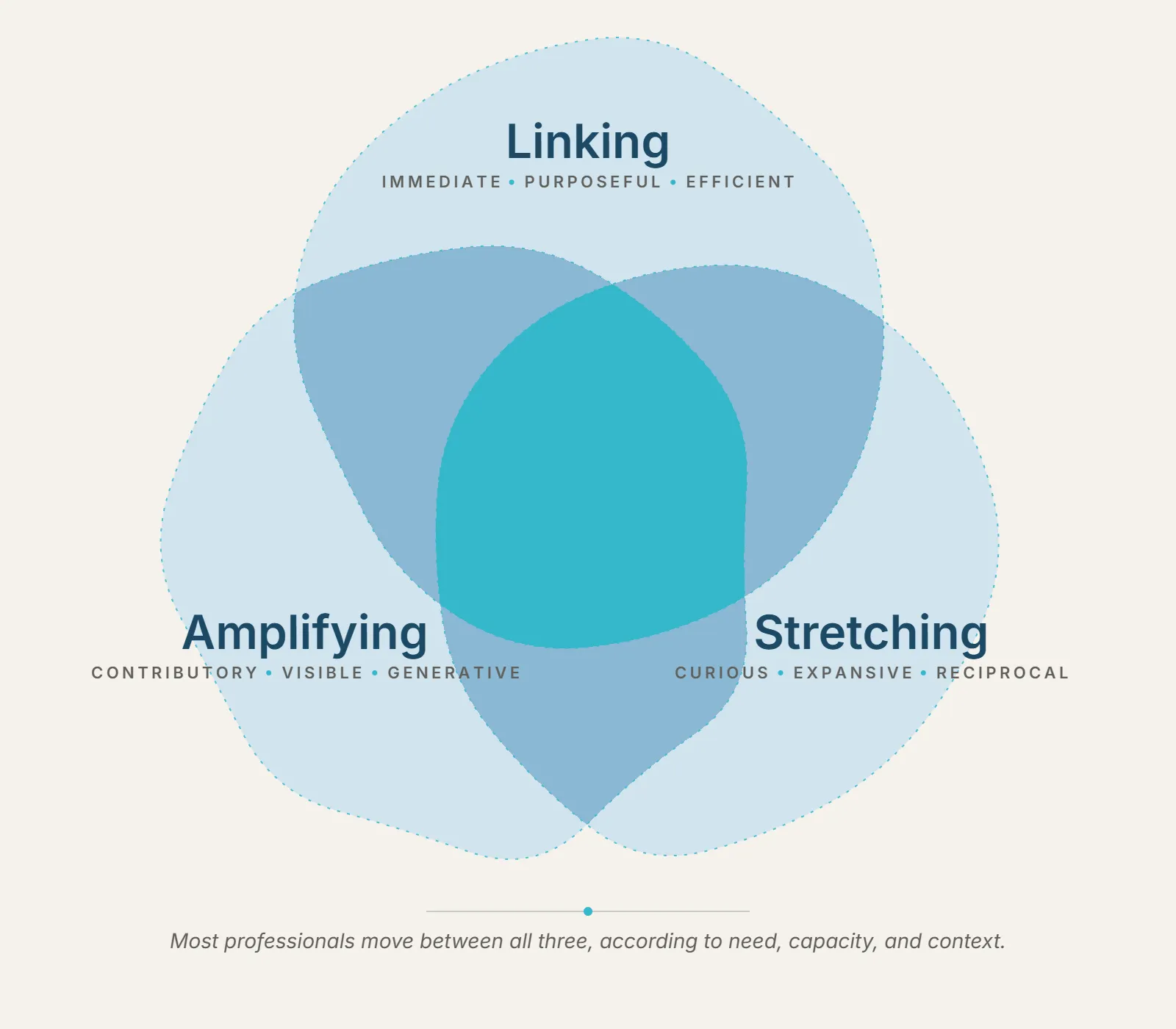
What emerged from that analysis was not a single, uniform experience of networked learning. It was something far more interesting: three distinct but interrelated sets of learning practices, which I named Linking, Stretching, and Amplifying.
The research drew on connectivism as its theoretical foundation: the understanding that in networked digital environments, learning is the active process of creating connections between nodes of knowledge, and that the capacity to see patterns and make new connections matters as much as any existing body of knowledge (Siemens, 2005). The LSA framework makes that theoretical claim practical. It gives connected professionals a vocabulary for what they are actually doing when they engage with their networks.
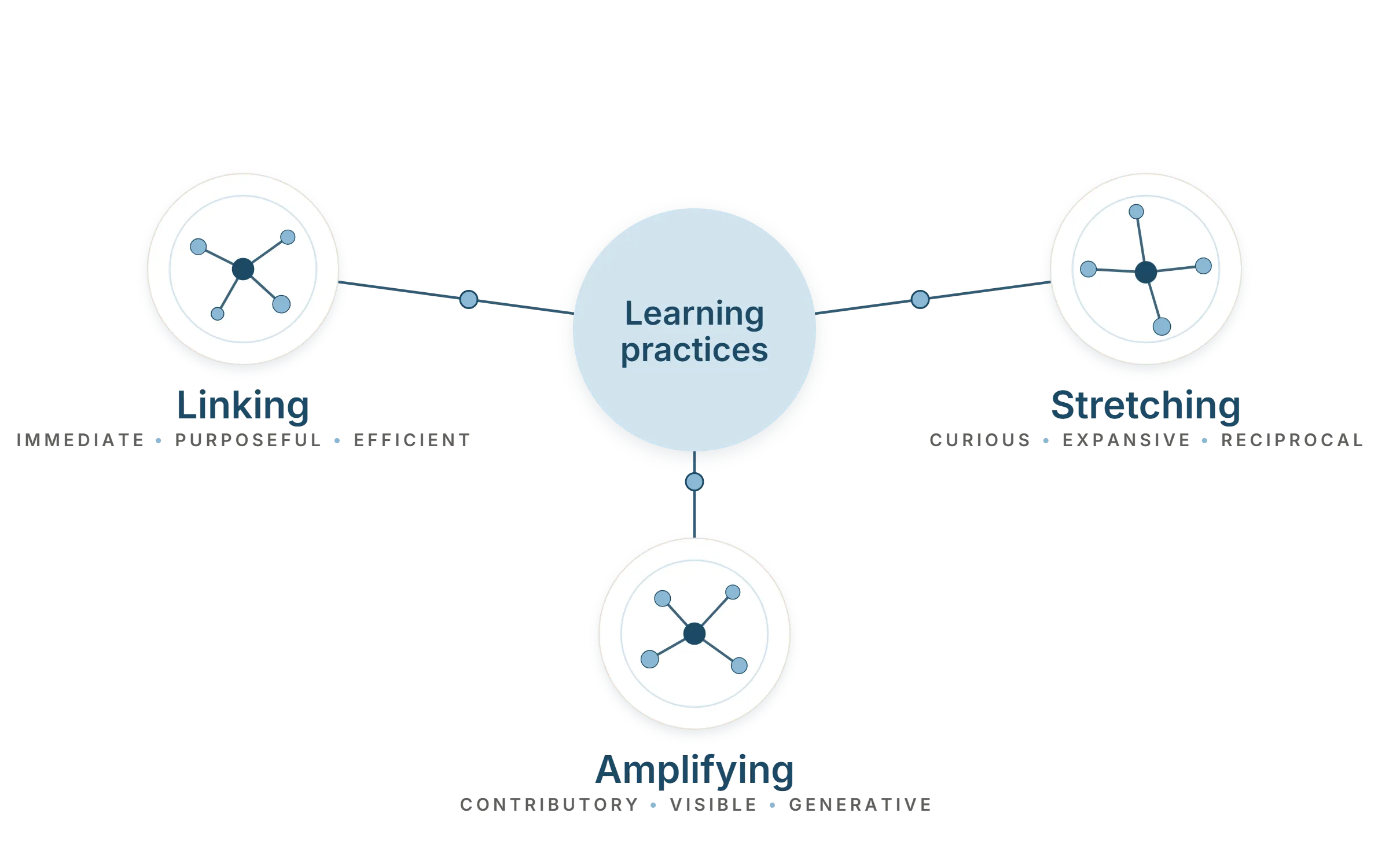
Linking: purposeful, efficient, goal-directed
Linking describes learning practices characterised by practical problem-solving. When you are linking, you connect with people or resources to meet an immediate or near-future professional need. The interaction tends to be short, specific, and efficient.
You might recognise linking in moments like these: posting a question in a professional Slack channel to find out which project management tool others use for a particular workflow; reaching out to a contact in another organisation to ask how they handled a policy change you are navigating; or scanning your LinkedIn feed for a case study that supports a report you are writing this week. In an educational context, this looks like a teacher asking their network for a lesson resource on a topic they are teaching tomorrow.
Linking is not superficial. It is the practice through which many professionals keep themselves functional, motivated, and informed on a day-to-day basis. For those who engage with their network primarily through linking practices, the network tends to be smaller and more curated, and the platforms they use are familiar and reliable. Staying connected to “network stars” — those well-followed individuals whose regular output consistently delivers value — is also a form of linking.
The key characteristic of linking is intentionality about a specific goal. You go to your network knowing what you need, and you retrieve it.
Stretching: curious, expansive, reciprocal
Stretching learning practices move beyond immediate need into the territory of curiosity and discovery. When you are stretching, you are expanding your network beyond your immediate professional circle, exploring ideas that are adjacent to your current role, and engaging in longer, more reciprocal exchanges with others.
This is the practice that builds depth. A policy analyst who begins engaging with economists and behavioural scientists outside their own department is stretching. A learning and development professional who spends time in online communities discussing emerging practice in organisational psychology — not because it applies directly to their current project, but because it interests them — is stretching. A school leader who reads and responds to research blogs in education leadership, contributing their own perspective and prompting discussion, is stretching.
Stretching practices tend to grow the network organically. As you offer and receive feedback and ideas, you become more visible and more known within your field. The platforms you use diversify, the connections you form span a wider range of roles and sectors, and your sense of your own professional identity begins to expand along with the network itself.
Stretching is not networking for its own sake. It is the practice through which professionals discover what they did not know they needed to know.
Amplifying: contributory, generative, visible
Amplifying is the most participatory set of practices within the LSA framework. When you are amplifying, you are not only consuming and connecting: you are actively creating, sharing, and contributing to knowledge within and beyond your network.
Educators who engaged with amplifying practices in my research described moderating online conversations, leading the organisation of events through their network, sharing their own research publicly, and collaborating with others to create resources and ideas that extended well beyond what any one person could have produced alone. They had developed a genuine presence within their professional community, and that presence had translated into career progression, unexpected opportunities, and a depth of professional connection that linking and stretching alone rarely produced (Oddone, Hughes, & Lupton, 2019).
The same dynamic applies in corporate and government contexts. A senior public servant who writes thoughtful pieces about policy design for a professional audience is amplifying. A consultant who hosts regular online roundtables and shares the synthesis publicly is amplifying. An HR leader who leads an industry working group and openly documents the process is amplifying. These professionals are not just consuming the outputs of their networks; they are generating knowledge that feeds back into them.
Amplifying takes more time and carries more risk — the risk of a public opinion, of intellectual visibility, of being wrong in a forum where others can see it. Those who engage with it consistently describe it as disproportionately rewarding.
| Education | Corporate | Government / Public Sector | |
|---|---|---|---|
| Linking |
|
|
|
| Stretching |
|
|
|
| Amplifying |
|
|
|
The practices are not a ladder
This point is very important, because it could easily be misunderstood.
Linking, Stretching, and Amplifying are not developmental stages. Engaging primarily with linking practices does not make you a less capable professional than someone who amplifies. These are descriptions of what people do, not judgements about who they are. A highly experienced professional may rely heavily on linking for a period when they are dealing with a demanding project, and shift into stretching or amplifying when they have more capacity to explore and contribute. Most people move between all three, fluidly and naturally, over time and across different aspects of their professional lives (Oddone, 2020).
What the framework provides is a vocabulary for that movement. And vocabulary matters, because naming a practice is the first step towards being intentional about it.
If you know that you have been operating primarily in linking mode for the past six months, you can ask yourself whether that is because it is what your context requires right now, or whether it is because stretching feels unfamiliar, or amplifying feels too exposed. That is a different, and more productive, question than “am I networking enough?”
Linking the LSA framework and Information Literacy
The LSA framework describes learning practices, but they are also underpinned at their core by information practices. Although my research into PLNs took place a few years’ ago, the need for this framework and the guiding information principles are needed more than ever. In my previous post, Reading the signal, I described information literacy as the capacity to engage with information deliberately, critically, and on your own terms: and each of the three practices in the LSA framework is, in a precise sense, an expression of that capacity.
Linking is where source evaluation does its everyday work: the habit of asking, almost automatically, whether the information you are retrieving is credible, purposeful, and worth your attention. Stretching is where self-direction and critical distance come into their own, as you pursue questions your formal training did not anticipate and assess unfamiliar ideas across new domains. Amplifying is what happens when those habits mature into contribution: engaging with information not as a consumer, but as someone generating knowledge that feeds back into the network. The information literacy capabilities I presented previously are not background reading for this framework; they are what make each practice possible.
Why this framework travels beyond education
The original research focused on teachers, and the educational context shaped what participants described. But the underlying dynamic, that connected professionals engage with their networks in fundamentally different ways, and that naming those ways produces more intentional and effective learning, does not belong exclusively to schools.
The conditions that make PLNs valuable are present across sectors. In many fields where formal training programmes may feel disconnected from everyday practice professionals are already building informal networks to fill the gap. In government, where policy problems cross departmental and jurisdictional lines, the ability to stretch beyond your immediate team and amplify your thinking into the broader policy conversation has direct professional and civic value. In any knowledge-based profession, the capacity to learn through connection is increasingly a core competency.
What the LSA framework offers these professionals is not a new activity to add to their calendar. It is a lens through which to understand what they are already doing, and to make more deliberate choices about what they want to do more of.
How I can help
I work with individuals and organisations across education, corporate, and government sectors to make professional learning more intentional, more connected, and more effective. If the LSA framework has prompted a question about your own practice, or about how it might apply to your team or organisation, I would genuinely like to hear from you.
You can learn more about Linking Learning Advisory and get in touch through my website or my Linked In account.
The question of how we learn through our networks is one I have been researching for years. Although the platforms we engage through might change, the need for this type of professional learning will always exist.
References
Oddone, K. (2020). Professional learning for connected educators: Linking, stretching and amplifying. Metaphor, 3, 14–19.
Oddone, K., Hughes, H., & Lupton, M. (2019). Teachers as connected professionals: A model to support professional learning through personal learning networks. International Review of Research in Open and Distance Learning, 20(3), 102–120.
Oddone, K. (2018, January 21). PLNs: Theory and practice. Linking Learning Advisory. https://www.linkinglearning.com.au/plns-theory-and-practice/
Richardson, W., & Mancabelli, R. (2011). Personal learning networks: Using the power of connections to transform education. Hawker Brownlow.
Siemens, G. (2005). Connectivism: A learning theory for the digital age. International Journal of Instructional Technology and Distance Learning, 2(1).
Trust, T., Krutka, D. G., & Carpenter, J. P. (2016). “Together we are better”: Professional learning networks for teachers. Computers & Education, 102, 15–34.



totally agree, Kay, for personal development
and using social networks and content curation to share knowledge
might be more useful for teaching than for research because researchers focused on one topic are not so willing to share on public space, preferring classical and more rewardings ways of publications and congresses
the titles of you papers support it
don’t you think it might be useful for students looking for choices and ways
Hi Gilbert
For students and teachers, I really do believe these are very practical skills to develop. Students may be surprised if they reach out to researchers to discuss their work, often researchers are thrilled to have someone interested in what they are doing :). Also, researchers might not want to share their current work, but for promoting and extending published work, having networks and curated collections of sources etc could be very useful.
Thanks as always for sharing your thoughts! 🙂
How can educators use Personal Learning Networks (PLNs) to expand their professional knowledge and create more meaningful connections beyond traditional learning environments?