

When Victorians vote on 28 November, first-time voters will cast a ballot with a phone full of opinions and potentially even more questions about which one to trust. The McKinnon Index 2026, released on 2 November, suggests that for many, that uncertainty may last well beyond this election. Australians whose education ended at Year 12 are less likely than graduates to say they can find good information about public policy, spot misinformation or understand how our democracy works (McKinnon, 2026). For most of them, school was the last place anyone deliberately taught them to read the information around them. Whether that teaching happened, and who led it, still depends on which school they attended and where it was.
Ten years ago this month, in the weeks after a US presidential election, I wrote a post called Fake news, filter bubbles and frustration. The frustration came from two places: research showing how poorly students evaluated the information they found online (Wineburg et al., 2016), and how rarely teacher librarians were invited into the response. The McKinnon Index suggests that frustration was warranted, and that the gap has widened since.
The McKinnon Index 2026 surveyed 4,273 Australians about how they experience, understand and participate in democracy (McKinnon, 2026). McKinnon is an independent, non-partisan, not-for-profit organisation that aims to facilitate the development of political leadership, increase public sector productivity, create a thriving democracy and accelerate policy innovation. This index is in its second year, with the 2025 Index forming a baseline measure of Australia’s democratic health.
What the Index found
The headline finding runs against the mood: Australians still back democracy itself. More than three-quarters of Australians (76.4%) still prefer democracy to any other system of government, and trust in the Australian Electoral Commission rose to 72.9%. What has weakened is confidence in the politics conducted inside those institutions. Trust in federal politicians fell 5.4 points to 30.5%, trust in political parties fell 6.8 points to 24.4%, and only 50.7% of Australians are satisfied with how democracy works in practice. Two information sources sit near the bottom of the trust table: news media (34.1%) and social media (16.7%) (McKinnon, 2026).
Beneath those averages, the Index draws out divides by education, age and personal circumstance, including where people live. The Index does not measure school libraries. But each theme points to capabilities that school libraries, led by qualified teacher librarians, exist to build.
Before going further, there are two cautions that I would like to highlight. Firstly, the Index measures what people report, including their confidence, and confidence is not the same as capability. Secondly, McKinnon notes that one year of movement within smaller demographic groups calls for informed evaluation rather than sweeping conclusions. Taking these points into account, the patterns still can tell us something about who feels equipped to take part in Australian democracy, and who feels a lack of control and opportunity for input.
The education divide is an information divide
Compare Australians whose highest qualification is Year 12 or below with university graduates (McKinnon, 2026):
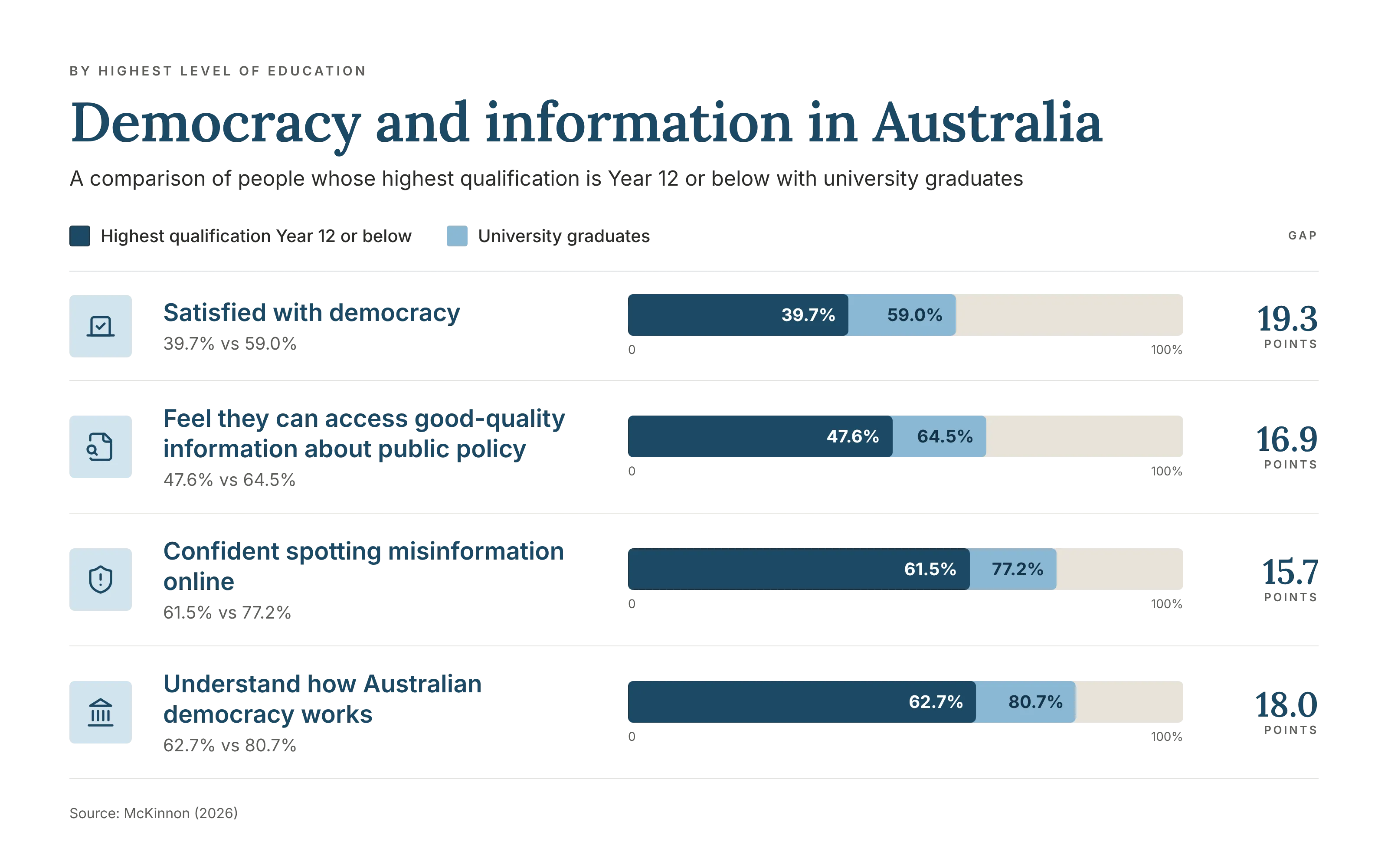
These statistics are not expressing political opinion. Instead, they describe whether people feel that they can find information, judge it and understand the system it describes. In other words, respondents’ levels of information literacy, and civic knowledge. The gap is also widening: satisfaction with and support for democracy fell over the past year among Australians whose highest qualification is high school, and held steady among graduates.
For many Australians, school is the final time that they are deliberately taught to read the information environment. What happens in those thirteen years has to last a lifetime of elections. The national data is not reassuring. In the 2024 National Assessment Program for Civics and Citizenship, 43% of Year 6 students and 28% of Year 10 students reached the proficient standard. Both results are the lowest since the assessment began in 2004 (Friedman et al., 2025). The drop between Year 6 and Year 10 tells us these capabilities do not hold unless someone builds on them, year after year.
This is why the work has to start in primary school and grow from there. In our survey of 91 qualified primary teacher librarians, my colleague Kasey Garrison and I found teacher librarians leading information literacy with conviction, often feeling as though they were the only person in the school doing so. We took the title of the paper from one respondent: “I am the only one teaching it” (Garrison & Oddone, 2026). When collaboration with classroom teachers is limited, students’ learning becomes fragmented and unequal. In secondary schools, teacher librarians told us that students and teachers alike were struggling to keep up with a changing information landscape and were often unaware of their own knowledge gaps (Garrison & Oddone, 2025).
Civics and citizenship cannot be a Year 6 unit and a Year 10 elective, and information literacy cannot be a single lesson on evaluating websites. Both are a continuum. Both need current, curated resources: a collection that reflects the information environment students live in now, not the one I was writing about in 2016. Students need time to practise evaluating sources, tracing claims and noticing whose voice is missing. Exposure to online information does not teach these skills.
McKinnon’s own Democracy Counts campaign calls for investment in civics education and digital and media literacy (McKinnon, 2026). I agree. My question is who will teach it, from what resources, and from which year level.
Disaffected young people, meaning-making and the manosphere
Young Australians are much less convinced by the value of democracy.
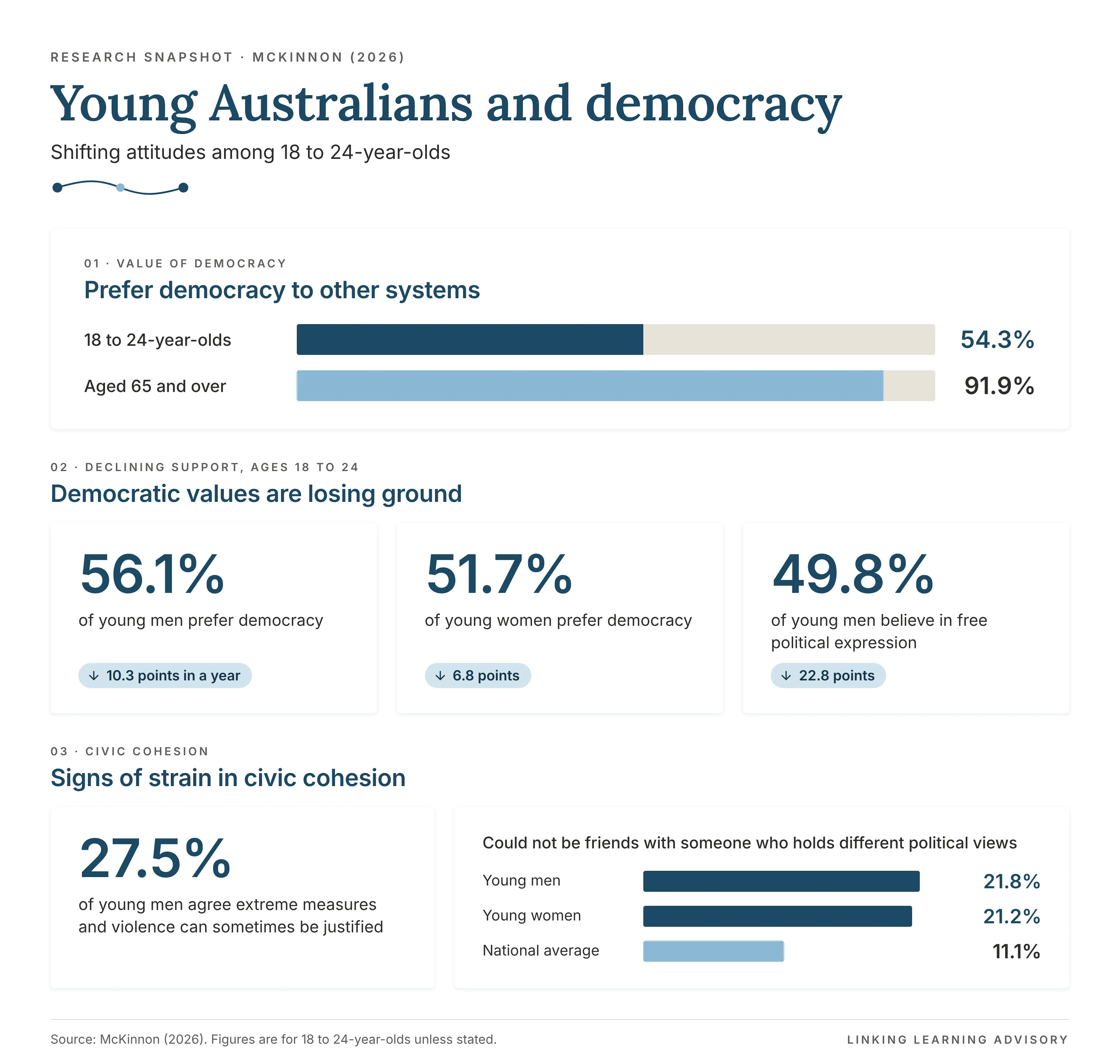
The Index does not tell us why, and I would be wary of anyone who claims a single cause. Research into militant masculinity and male grievance identifies social media and time online as having a potentially negative impact upon young people’s views of democracy (Roose, 2025), while the eSafety Commissioner (2026) describes how recommender systems and algorithms can push users towards conformity of opinions and echo chambers, potentially promoting harmful ideas and stereotypes. Both recommend education and building awareness as the most powerful antidotes for vulnerable young people.
That recommendation describes information literacy, and the effectiveness of awareness and capability building is nothing new; but the need is greater than ever. In 2016 I asked readers to think again about algorithms and filter bubbles. In 2019 I wrote about clickbait and the rabbit holes it opens. This year, in Signal Check: Filter bubbles and sycophantic machines, I looked at what happens when the systems we consult are designed to agree with us. The manosphere rarely arrives labelled as politics. It arrives as advice about fitness, money and confidence, and the politics follows. In research I conducted with Margaret Merga on how students evaluate health information in social media videos, students knew that videos featuring online health information could be misleading, but lacked strategies to judge its credibility (Oddone & Merga, 2025). That gap between awareness and strategy is exactly where persuasive content does its work.
Resistance is not built by removing young people from these spaces. The under-16 social media age limit has not taken young people out of them, as I argued in Neither the genie nor the bottle. Resistance is built by giving young people the strategies to make meaning, and practising them so they become second nature: noticing when content is engineered to provoke, asking who profits from their attention, comparing sources, and talking it through with adults they trust.
The friendship finding deserves attention too, because it is the least technical and possibly the most important. Democracy depends on people who can respectfully disagree and still sit next to each other. A school library with a well-developed collection is one of the few places a young person can go to investigate opposing views and seek the experiences and perspectives of others, through fiction and non-fiction. As I wrote in School library collection development: It’s not as simple as you might think, a considered collection presents perspectives a student’s feed never will. The library is where disagreement is modelled and practised, respectfully, every day.
A democratic deficit by postcode
Place matters as well.
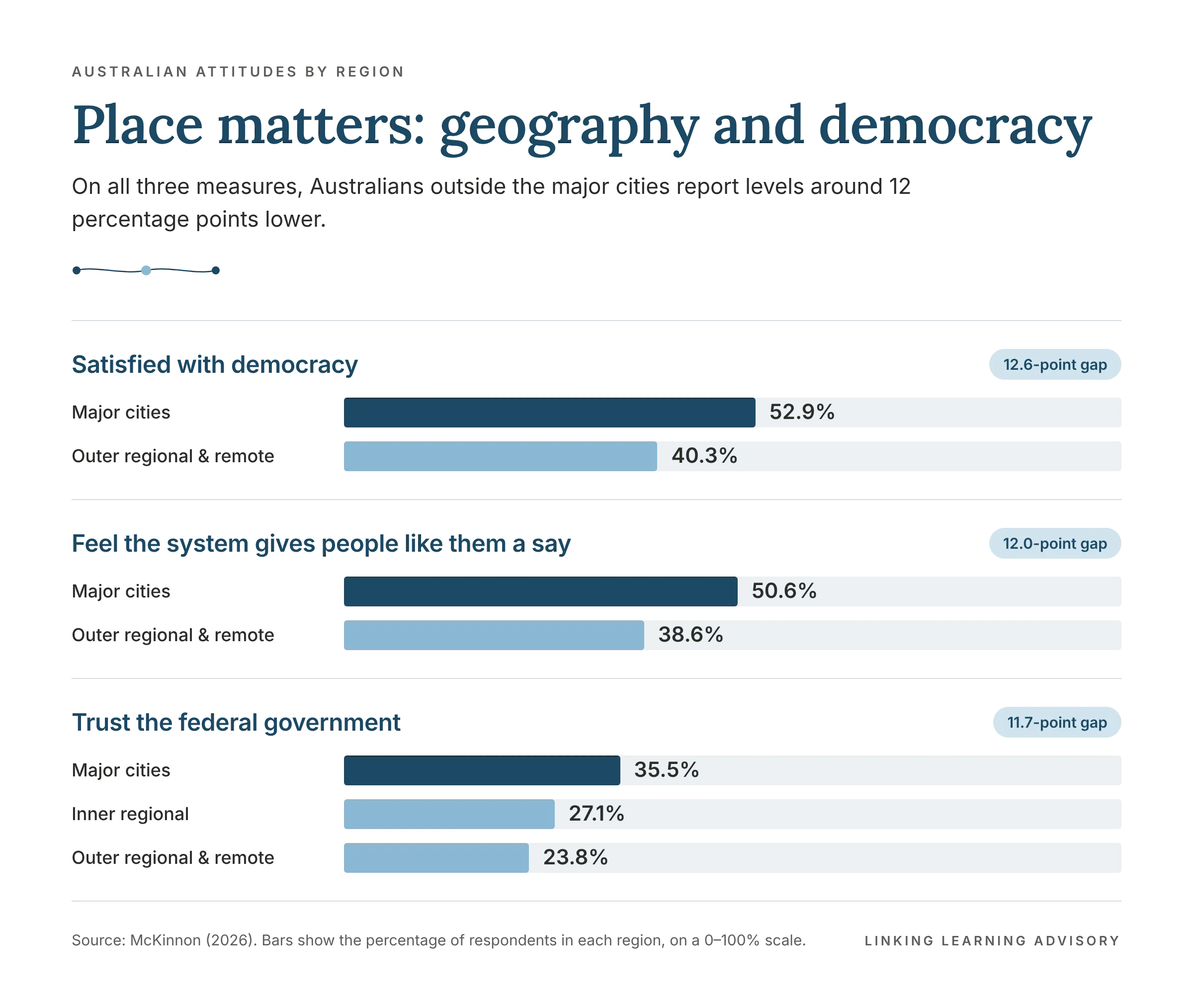
The gap remains. McKinnon’s 2025 Index found the regional deficit was not explained by people understanding democracy less (McKinnon, 2025), so school libraries are not the whole answer. But the school data follows the same map.
Students in major cities generally outperformed their regional and remote peers in civics and citizenship (Friedman et al., 2025). In ICT literacy, the proportion of major city students reaching the proficient standard was roughly twice that of students in remote schools (Friedman et al., 2026). To raise levels of these literacies, one strategy has longstanding evidence: well-resourced school libraries led by qualified staff contribute to literacy, learning and wellbeing across socio-economic settings (Hughes et al., 2025), and decades of impact studies link strong library programs to student achievement regardless of background (Lance & Kachel, 2018).
Yet in most Australian states and territories, a qualified teacher librarian is not mandated. Even in New South Wales, where the role is mandated, teacher librarians report being moved from the library into classroom teaching, as I wrote in The answer is in the library. We keep looking elsewhere. We do not even count them: when Kasey and I designed our primary study, we could not find national data on school library staffing (Garrison & Oddone, 2026). When something is optional, it goes to the schools that can afford it. A school library with a qualified teacher librarian becomes a feature of well-funded metropolitan schools, and students in the regions, who already report feeling least heard, are the most likely to go without.
So the argument is not that every school would benefit from a library. It is that a staffed, resourced library with a qualified teacher librarian should be a condition of schooling in every school, in every postcode, and not a discretionary line in a budget.
Five questions to ask before you vote (or conduct any research, really)
Whether you are voting for the first time or the fifteenth, these questions work on any post, video or flyer that crosses your path between now and polling day, and in fact make a good habit to practice whenever making a decision informed by online media.
- Who made this, and what do they gain if I believe or share it?
- Was this made to make me angry or afraid before it makes me think?
- Can I find the same claim from a second source with a different perspective?
- Am I reading the original (a policy document, an official website, an authentic and credible author’s own material) or someone’s summary of it?
- Whose voice has been missing from what I am reading?
Making democracy truly participatory
McKinnon argues that a generation less convinced by democracy needs to “experience a political system worth participating in” (McKinnon, 2026, p. 6). I agree, and I would add a step that comes first. Before young people can experience a system as worth their participation, they need to be able to understand it: to locate reliable information about its impacts, evaluate claims being made, and spot attempts to sway their opinion and influence their thought.
Those skills do not come through osmosis. They must be taught and practised. This is most effective when the learning starts early, builds over years, draws on current and diverse resources, and is taught collaboratively by teachers supported by qualified teacher librarians. A lighthouse does not steer the ship. It makes the coastline visible so the people at the helm can choose their own course. Every school in Australia, in every postcode, deserves not just a library space, but one staffed by a qualified team who can shine that light brightly for the entire school community.
If you are reading this before 18 November, you might be interested in joining us in Canberra for the Pathways to Democratic Information Resilience: Civic Media and Information Literacy in the Curriculum and in Society Symposium at the University of Canberra. If you’ve missed this event but the post interests you, you might also like Who’s reading for you now? and One for the books: Schools need libraries too.
References
Democracy Counts. (n.d.). News & resources. Retrieved November 3, 2026, from https://democracycounts.org.au/resource-hub
eSafety Commissioner. (2026). Drifting into an ‘echo chamber’? Take control of the algorithms that shape your feed. https://www.esafety.gov.au/young-people/echo-chambers-and-your-feed
Friedman, T., O’Malley, K., Eveleigh, F., & Schulz, W. (2026). National Assessment Program – ICT literacy 2025: Public report. Australian Curriculum, Assessment and Reporting Authority. https://research.acer.edu.au/ict_literacy/29
Friedman, T., O’Malley, K., Schulz, W., Nixon, J., Hall, D., & Eveleigh, F. (2025). National Assessment Program – Civics and citizenship 2024: Public report. Australian Curriculum, Assessment and Reporting Authority. https://nap.edu.au/docs/default-source/nap-sample/nap-cc-2024-public-report.pdf
Garrison, K. L., & Oddone, K. (2025). “It is a skill everybody needs to learn”: Australian teacher librarians steering secondary schools through shifting information landscapes. Journal of Information Literacy, 19(1), 48–68. https://doi.org/10.11645/19.1.657
Garrison, K. L., & Oddone, K. (2026). “I am the only one teaching it”: Australian primary teacher librarians leading information literacy. Journal of Library Administration, 66(2), 138–157. https://doi.org/10.1080/01930826.2026.2630576
Hughes, H., Allan, C., & Bozorgian, H. (2025). School library contributions to student literacy, learning, and well-being: The latest evidence, 2014–2023. In D. Oberg & L. Marquardt (Eds.), School librarians and principals leading together: International perspectives (pp. 191–208). Bloomsbury Libraries Unlimited.
Lance, K. C., & Kachel, D. E. (2018). Why school librarians matter: What years of research tell us. Phi Delta Kappan, 99(7), 15–20. https://doi.org/10.1177/0031721718767854
McKinnon. (2025). 2025 McKinnon Index: An annual dashboard of democratic health. https://apo.org.au/node/332763
McKinnon. (2026). McKinnon Index 2026: Key findings. https://mckinnon.co/index
Oddone, K. (2016, March 23). Algorithms and filter bubbles: Time to think again. Linking Learning. https://www.linkinglearning.com.au/algorithms-and-filter-bubbles-time-to-think-again/
Oddone, K. (2016, November 28). Fake news, filter bubbles and frustration. Linking Learning. https://www.linkinglearning.com.au/fake-news-filter-bubbles-and-frustration/
Oddone, K. (2019, March 15). Clickbait, consternation and that elusive silver bullet: Falling down the rabbit hole. Linking Learning. https://www.linkinglearning.com.au/clickbait-consternation-and-that-elusive-silver-bullet-falling-down-the-rabbit-hole/
Oddone, K. (2019, August 19). School library collection development: It’s not as simple as you might think. Linking Learning. https://www.linkinglearning.com.au/school-library-collection-development-its-not-as-simple-as-you-might-think/
Oddone, K. (2019, October 1). One for the books: Schools need libraries too. Linking Learning. https://www.linkinglearning.com.au/one-for-the-books-schools-need-libraries-too/
Oddone, K. (2026, May 28). The answer is in the library. We keep looking elsewhere. Linking Learning Advisory. https://www.linkinglearning.com.au/the-answer-is-in-the-library-we-keep-looking-elsewhere/
Oddone, K. (2026, July 14). Signal Check: Filter bubbles and sycophantic machines. Linking Learning Advisory. https://www.linkinglearning.com.au/signal-check-filter-bubbles-and-sycophantic-machines/
Oddone, K. (2026, July 20). Who’s reading for you now? Linking Learning Advisory. https://www.linkinglearning.com.au/whos-reading-for-you-now/
Oddone, K. (2026, September 8). Neither the genie nor the bottle. Linking Learning Advisory. https://www.linkinglearning.com.au/neither-the-genie-nor-the-bottle/
Oddone, K., & Merga, M. (2025). Evaluation strategies of school students accessing health information in social media videos: A case study investigation. Journal of Library Administration, 65(2), 214–234. https://doi.org/10.1080/01930826.2024.2437964
Roose, J. M. (2025). Militant masculinity, male grievance, and the politics of democratic decline. Journal of Gender Studies. Advance online publication. https://doi.org/10.1080/09589236.2025.2576811
Wineburg, S., McGrew, S., Breakstone, J., & Ortega, T. (2016). Evaluating information: The cornerstone of civic online reasoning. Stanford Digital Repository. http://purl.stanford.edu/fv751yt5934


